Rachel Zidaroff is the CEO of United Rehabilitation Services (URS), a Dayton nonprofit organization celebrating 70 years of service. URS enhances the quality of life for children and adults with disabilities or other special needs through specialized programs that promote independence, community inclusion, and support for families.
Tune in for this episode, where Rachel shares about her journey with URS, the organization’s evolution and innovative approach, and her vision for creating a more inclusive future for everyone.
Listen Now:
Episode Transcript:
David Bowman
Welcome to Creating the Future. I’m David Bowman,
Evelyn Ritzi
and I’m Evelyn Ritzi,
David Bowman
and today we’re joined by Rachel Zitaroff, the CEO of United Rehabilitation Services of Greater Dayton, more commonly known as URS, Rachel, welcome to the show.
Rachel Zidaroff
Thank you guys so much for having me today.
David Bowman
Thank you for joining us. We’re so excited to have you here. We’d like to start just by having you tell us a little bit about your background and how you came to join URS, and and did you always you know want to be involved in nonprofit work?
Rachel Zidaroff
So yeah, that’s a great question and one I’ve put a lot of thought into as I’ve transitioned into this CEO role, and I really feel like this is a mission that I have been living every day that’s finally coming to fruition. I was given the opportunity to start in the finance department at URS 22 years ago, after starting my career in finance in a corporation that was a for-profit environment and just didn’t feel right for me, and coming into the finance position at URS and walking through the halls, it was just meant to be. Back in 2004, it felt like the right place from the very beginning, and as I built on my career, I was able to expand into the human resources management position in 2008, 2009, and then recently, before the CEO position, I was the chief operating officer for about 11 years. So, having the experience to work my way through all of the different departments and have my hands in really a little bit of everything at URS just really made it feel full full circle when I was given the opportunity to be the CEO, and it just couldn’t be more fulfilling right now.
David Bowman
Well, and there’s a whole lot of everything at URS. Oh, there really is.
Rachel Zidaroff
Yes, that is right.
Evelyn Ritzi
Yeah, let’s dive into that because URS is celebrating its 70th anniversary in 2026. Congratulations! Thank you. So exciting.
Rachel Zidaroff
Yeah.
Evelyn Ritzi
Can you walk us through the history and kind of the evolution of the organization and its mission today?
Rachel Zidaroff
Back in the late 1950s, a mom and dad, Marg and Jim Bristow, were struggling to find care for their daughter. And in the 50s, care for a child with disabilities, especially cerebral palsy, just wasn’t something that you saw all the time. And she was super passionate about making sure that her daughter had high quality care and was given inclusive opportunities, and that just was unheard of in that day and age. So, she had traveled all over the country trying to find different ways to care for her daughter, and stumbled upon a United Cerebral Palsy nationwide kind of chapter, and got connected with the right people. And before she knew it, she was opening up a UCP branch on Valley Street near Barney’s at the time, Dayton Children’s, and one thing has led to another. And in 1999, we purchased the property we’re in now on the corner of Old Troy Pike and Need Moore, and left the Dayton Children’s property and expanded our services and our footprint, and brought the hearing and speech program with us, so now we provide you know therapies and lots of other things, as David mentioned, as part of that full continuum of care, and really showing the community 70 years of investment and what that looks like into becoming an inclusive community in Dayton.
Evelyn Ritzi
Wow
David Bowman
And it’s — having been to to the facility out there. I mean, it’s amazing. You just you think you know what you’re gonna you know see when you walk in when you’re walking in the door, and it’s I mean it just blows your mind because it’s so there are so many ways in which you help people there. So I was wondering for folks who haven’t been out to URLs or maybe haven’t been been there in a minute. Tell us about the programs, the services that you offer, and maybe walk us through sort of a typical. I know that that might not be a typical day at URS, but you know, walk us through like what’s going on out there and what might people see on a on a general day.
Rachel Zidaroff
Yeah. So yeah, a typical day is hard to just. But on a general day, so if you came in there tomorrow morning, I would say that you would definitely see high-quality early childhood education happening in an inclusive environment. So we do provide childcare to kids with disabilities, but we also include their siblings. They’re typically developing siblings, their cousins, their family members who might just want a high-quality, inclusive environment. We also have about 25% of the kids we come that don’t have a developmental delay or disability, and what you will see happening is therapies, OTPT, and speech, occupational therapy, physical therapy, and speech therapy happening right alongside that high-quality early education, while high complex medical needs are also being met, so maybe tube feedings, catheterizations, insulin monitoring, seizure monitoring-all of those things happening at one time in the childcare environment. So think about a mom or a dad who needs to get back to work with a six-week-old, knowing that they have that type of care happening allows them that opportunity to get back to work sooner in a a level of comfort. If you don’t come to our child care, but you still need those outpatient therapy services, we also provide those. So you can live at home with your mom or dad, or go to typical child care and need just some supports in that area. You can come in for outpatient services too, so our therapy is provided to the community in general. And then, once you age into discovering whether or not you want to work someday, we also provide employment services to transition youth through our summer youth program project search that we have going on at Springfield Regional Medical Center, which is a nine-month internship program for transition high school students who are trying to discover what they’d like to do in the community someday, and then we also do competitive employment placing. So we will place you in a job in the community and work alongside you with job coaching and job development until you’re ready to work on your own. And if you’re maybe not ready to work someday and you want to come to URS as an adult for socialization, community engagement, high quality services as an adult with high complex medical needs. You can also get that in our adult day services program.
David Bowman
And you mentioned Springfield, where that program is. Tell us about sort of the the footprint of URS and the communities that you serve, what does that look like?
Rachel Zidaroff
So, the majority of the services we provide are in Montgomery County because that’s our primary building. Yeah, the brick and mortar of URS sits there. But to your point, we provide those job seeking skills services and job coaching and job development, and that happens in all of our surrounding counties. So, Miami County, Clark County Greene County Warren County, when you’re doing things that are community-based, you can often spread that footprint without that brick-and-mortar or those walls being barriers to the services. So we are finding that even some of our community integration programming, where we’re taking small groups of adults with disabilities out into the community to volunteer at places like Booneshof, Miami Valley Meals, Five Rivers Metro Parks, we’re able to expand on the services we’re providing outside of the building, and including more people from those outlying counties in our services.
David Bowman
And that’s such a valuable, a valuable platform of services for the community in so many ways. When you think about the need for workforce, when you think about the fulfillment of you know getting people out to to work in those in those positions and fill those opportunities and figure out hey what what is it that I’m interested in doing, talk a little bit about that and how those partnerships work and just how that comes to comes to be in the community.
Rachel Zidaroff
Okay, so let’s say we have a referral for an individual who’s looking for a job and they are new to the workforce, so they might need some assistance with building a resume. Yeah, actually exploring some career opportunities. So we’ll sit with them, walk them through the process, kind of go back and forth on a couple drafts with them if that’s what they need, and then we show them how to look for jobs on their own, and we actually help them with the application process. Take them to the interviews, show them how to dress, talk to them about you know how to conduct yourself in an interview, how eye contact, you know, just kind of go through those soft skills that you don’t always learn when you are learning about living on your own in the community, you know how to have a conversation with a potential employer. Those are some of the things. Mock interviewing, we do those types of things, and then we build relationships with local employers. That’s really key. Who is friendly for hiring individuals with disabilities? Who has a process for onboarding that is a little more simple that someone who might have some barriers to learning can understand easily and not feel like they are already behind the process when they start. So we really work hard to build on community partners and how we can bring individuals into those environments and feel supported. As they may be getting their first job and learning how to become a productive citizen of society and live on their own and all those levels of independence that you and I take for granted that others are learning for the first time after they graduate high school. So it’s really just walking them through the process and meeting them where they’re at because everybody’s needs look a little different.
David Bowman
Yeah.
Evelyn Ritzi
What might surprise people, maybe when they walk through the doors of URS, whether it’s a volunteer or a family coming through for the first time? What are some things that, wow, I didn’t know you did this, or I didn’t know this was here?
Rachel Zidaroff
So, I think the biggest thing I hear is we thought you only did this. So, like someone comes to us for childcare because they heard that we have inclusive childcare and their kiddo really needs nursing supports. They walk in the door and they realize not only are they going to get nursing supports, but they’re also going to get offered those therapies that they might have otherwise been leaving work early for or having to miss an extracurricular activity in the evening because they needed to go to these therapy appointments in the evening, so they find out that there’s this additional layer of relief that’s going to happen when they come through our child care program, or if you’re a donor or a volunteer and you’re walking through for the first time, you may have heard about our adult day services program and all the community volunteering we’re doing, but you had no idea we had that inclusive child care and that we start serving people when they’re six weeks of age. So I think the biggest thing I hear is, “Wow, we had no idea you did all of this. It might be the one thing people are familiar with, and then when they see it, they’re just like, “This really is a one-stop shop. You know, you can start here when you’re six weeks of age and age out with us, or stay with us through your senior years, and it’s not just support for that individual, but their whole family. How can we help your family be more successful and support you along the way?
David Bowman
Yeah, I’ll tell you, I was from a personal standpoint, I was really surprised at the level of call it sophistication and specialization. So not just there were a lot of things, but there were a lot of really, you know, in my mind, cutting edge or very specific types of therapies, very specific pieces of equipment that you know functioned in very specific tasks. I was really surprised by by that as an aspect, maybe you could talk about a few of those, but also combined with just I don’t know, maybe I expected it, but just the level of compassion and care and patience and just you could see the the relationship between the people providing the therapy and the people receiving the therapy services, that there was something deeper, you know, really deep a connection there that just it comes across right away,
Rachel Zidaroff
And that’s something that’s so hard to put into words, but you feel it when you’re walking through the building, and it’s true. Our therapeutic intervention team is second to none. Not just because they work for URS, but they really do have a level of expertise and compassion that I’ve just never seen before. They follow kids from birth all the way to kindergarten. Sometimes, just Friday we had our preschool graduation for the kids that are transitioning from preschool to kindergarten, and a couple of our therapists have been with these kids since they were born, and they were there. You know, like it’s they’re part of the family. They’re not just their therapists. They have seen them make achieve milestones that maybe they their parents were told they would never achieve. Yeah, taking their first steps, saying their first words at URS. You know, and as a team, you know, the if it wasn’t for the high quality childcare, in addition to that therapeutic support and the family involvement, none of that would happen. You know, so it takes more than just the therapist to make it happen, and to speak to some of those unique things that we use to make those things happen. If it wasn’t for the generous support of foundations in our community and donors, some of that stuff wouldn’t be possible. You know, as a private nonprofit, we are here, and every dollar we raise stays right here in this community and goes to these programs. So we have a very unique thing at URS, the Spider Cage Universal Exercise Unit, and our physical therapy area, and that piece of equipment is the reason why so many kids are taking their first steps when parents were told they would never walk. It’s a very unique piece of equipment that our physical therapists are specially trained in to use, and it’s a system of weights and pulleys that you really have to see to believe, and if you’re curious about it, go to our website ursdateon.org. There’s some information there on our physical therapy page about it, with some pictures and videos. But you have to be very intentional, and you have to make a commitment to that type of a therapy intervention. And these families and our therapists do. And they come two, three times a week, and the kiddo is put through some rigorous treatment sessions. But the end goal is independence, you know, and something again that you and I take so for granted that these kids they want to walk, they want to be independent, they don’t want to use their braces and their walkers anymore, and their faces just light up when they become weight bearing and they take those first steps. One of the other things we’re doing right now that’s a super exciting project. We provide pediatric aquatic therapy, which is therapy in the water. So the pool is about 95 degrees all the time. It’s very buoyant. So imagine when you get in the water, how your body feels. So if you’re a wheelchair user, or you have muscles that are kind of constricted in the same place all the time, getting in the water causes a sense of relaxation that a therapist can then perform a productive session of therapy that they may not otherwise be able to do on land. We discovered in December of last year that our therapy pool that was existing then was leaking in the walls and into our foundation and had been for quite some time, and to the point of our foundation was like turning into sand underneath, and we didn’t know it until it was really too late. So we had to close the pool in December, and we are now in coming to the end of the project where we took out the above ground pool and we are putting in an in ground pool that is twice the size and will be salt water versus chlorine, and allow things like bed sores and continuous injuries and things that were otherwise not really healing in the chlorine.
Rachel Zidaroff
The salt water will add to that healing process, and then we will be able to have multiple sessions of therapy happening at the same time versus just one. So that aquatic therapy pool will be opening very soon, and I’m really excited about that. But it’s been a project that’s been in the works for quite some time. So the patients are excited, the therapists are excited, and it’s very unique. There’s not another pediatric aquatic therapy program in this region. Wow.
David Bowman
Well, when you think about the impact of URS, and you’ve been there for for a long time, is there a client or a family story that really stands out to you as just it’s going to stick with you forever?
Rachel Zidaroff
I have a couple, but I can think of one that’s huge impact. So it’s a family. We were it was really early in my career at URS. I’ve been there about 20, almost 23 years, and we were lucky enough to have a family of quadruplets come to our childcare. They were toddlers, and two of the four had significant delays and needs that the other two didn’t really have. So they were going through our therapy program. They were receiving early childhood intervention through our partnership with Miami Valley Head Start. They were transitioning from our toddlers into preschool. So they were learning all of the get set for school things that we offer there, and then they went to school, and that’s normal. That’s what happens with a lot of the kids we serve because everybody has to go to school. But you never really know what happens after school. Well, we were lucky with these kiddos because when they became teenagers, they needed our supports and employment services through the summer youth program that I was talking about. So, mom and dad remembered the services they had gotten at URS as kids and knew that we had provided additional services and reached back out. and The two boys came through our summer youth program where they went into the community four weeks at a time and worked with a job coach and a small group, an employer, and learned some job skills through their junior and senior years of high school, and then when they graduated, they also needed some help finding a job. So one of them is working at a local establishment here in Dayton, and still to this day is earning a paycheck and contributing to society and supporting himself as a result of the services that we provide, and to me, that’s the definition of that lifetime of service. That that family is always going to remember us, and they’re going to talk about us in their circles. And when someone else needs those services, I will hope that they will mention our name. Yeah.
Evelyn Ritzi
So if someone’s listening and they feel inspired, like we all do, maybe they want to get involved as a volunteer or supporter. What are some ways that someone could get involved with the mission of URS?
Rachel Zidaroff
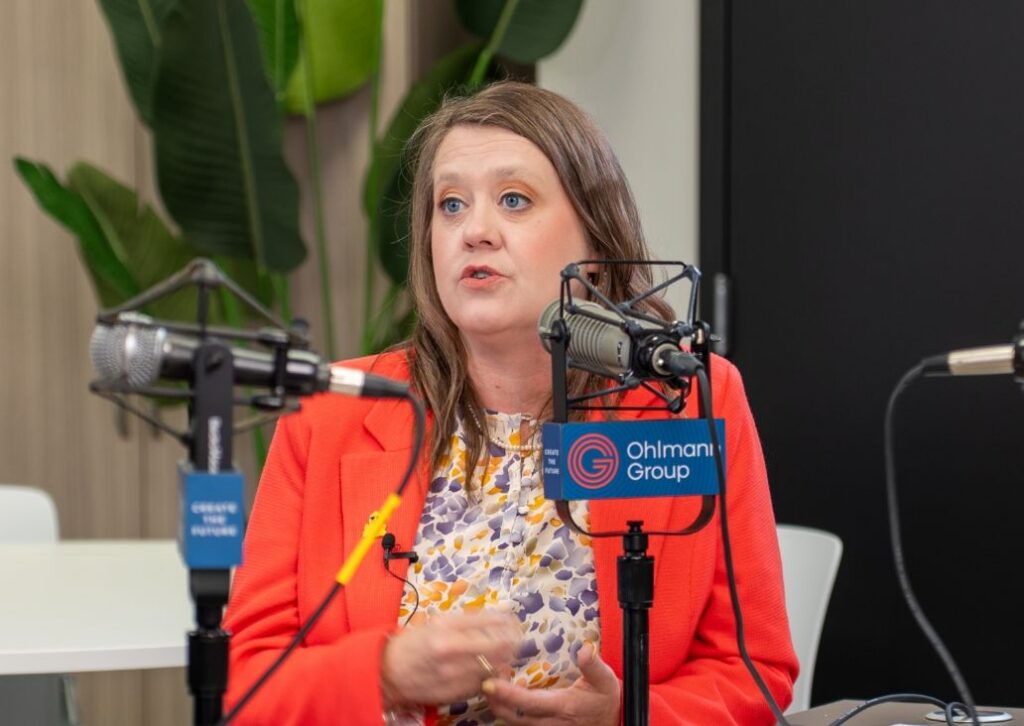
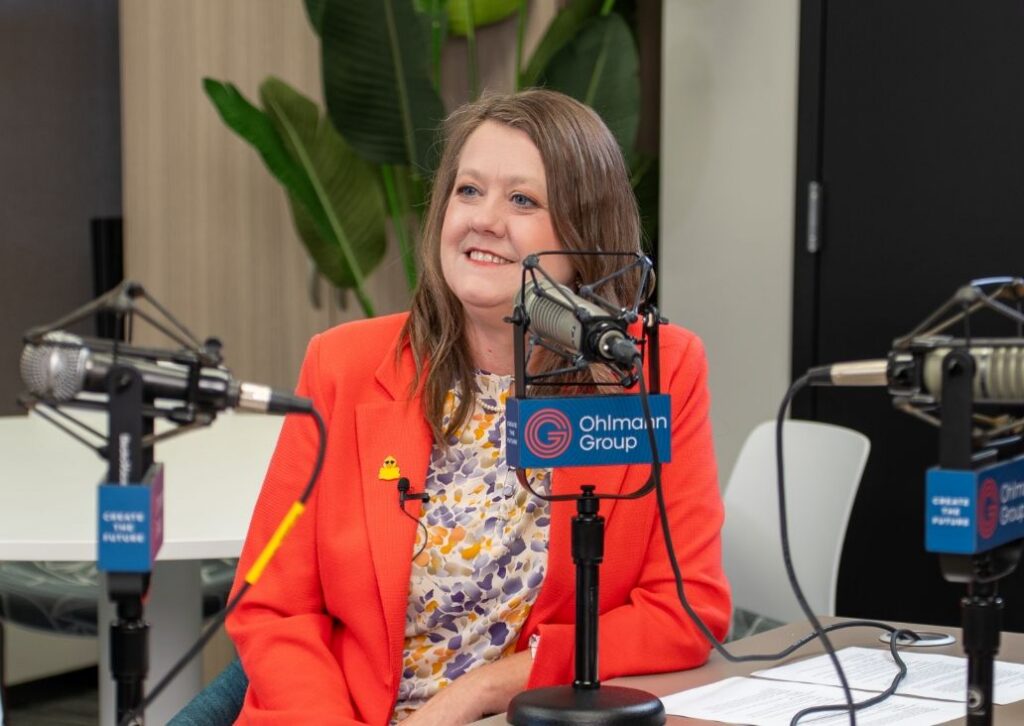
Sure. So I’m not sure if you guys can see this, but I do have this little rubber duck pin on. So I’ll have to mention that first because that’s our most upcoming event. But we do a lot of special events in the community to support that funding gap as a nonprofit, and our biggest one that most people know us for is the Rubber Duck Regatta. We put 20 zero ducks in the Great Miami River here downtown as part of the Hispanic Heritage Festival every year, and this year for the third year. In a row, it’s presented by AES Ohio, and we are scheduled to that on september 19. So, if you are looking to get involved and you want to volunteer, we need a lot of people to get 20,000 ducks out of that river. So, that’s always a fun way to get involved, or even just to pound the pavement with us at the Holiday at Home Festival and get in the parade and spread the word about the ducks. There are lots of ways you can volunteer that way. If you want to come to URS and read to the preschoolers or play games with the adults, you know they love Uno. They love to you know sit around and watch podcasts and listen to podcasts and have you know someone to do that with. If that’s something you’d like to do, there’s also a tab on our website to get involved and volunteer, and there’s a list of things you can do: arts and crafts with the adults. If you have a special skill and you can play the guitar, and you just want to share that with somebody, you can stop by and do that because that’s something that enriches the lives of the adults we serve every day. They don’t get to go in the community like you and I regularly and see the live music and the performances. We just had Olahana and her Polynesian dancers there yesterday, and we had a little luau. You know, so there’s all types of ways that you can bring your passion, and we can share our passion with you to at URS. So, yeah, check out the website and give me a call. Like we can talk about what your interests are, and we’ll get you involved.
David Bowman
That’s terrific. So, one final question we ask all of our guests on the show: What’s the future that you want to create?
Rachel Zidaroff
That’s such a big question. Oh, and I got big dreams, guys. My dream is, you know, that inclusion is just for everybody, and it’s just a thing. We don’t have to talk about it like it’s not existent. You know, libraries are for all, museums are for all, Dayton is for everybody. You know, and how can we create an environment where everyone’s abilities are what we see and not their disabilities? That’s really my goal, and through advocacy and leadership, that’s something that I would love to see make an impact on in this community. And at URS, my goals are to make sure that we’re always innovative and that we’re always thinking about what’s next to enhance the independence of the people we serve. That is endless right now. When you think about where technology is going, and there’s a lot of barriers that are being put in place with legislation and Medicaid cuts, and what does that really look like for the people we serve? So being aware of that and making sure that we’re not leaving any door closed, and making sure that every person in the state that represents those decisions and is making those decisions knows who they’re affecting. I think that’s my like biggest goal for the future, which is a lot. Yeah. Hey,
David Bowman
That’s fantastic. Well, thank you so much for being our guest today. We really appreciate it.
Rachel Zidaroff
This was great. Thank you guys so much for allowing me to just share a little bit about URS with our community. I really appreciate it.