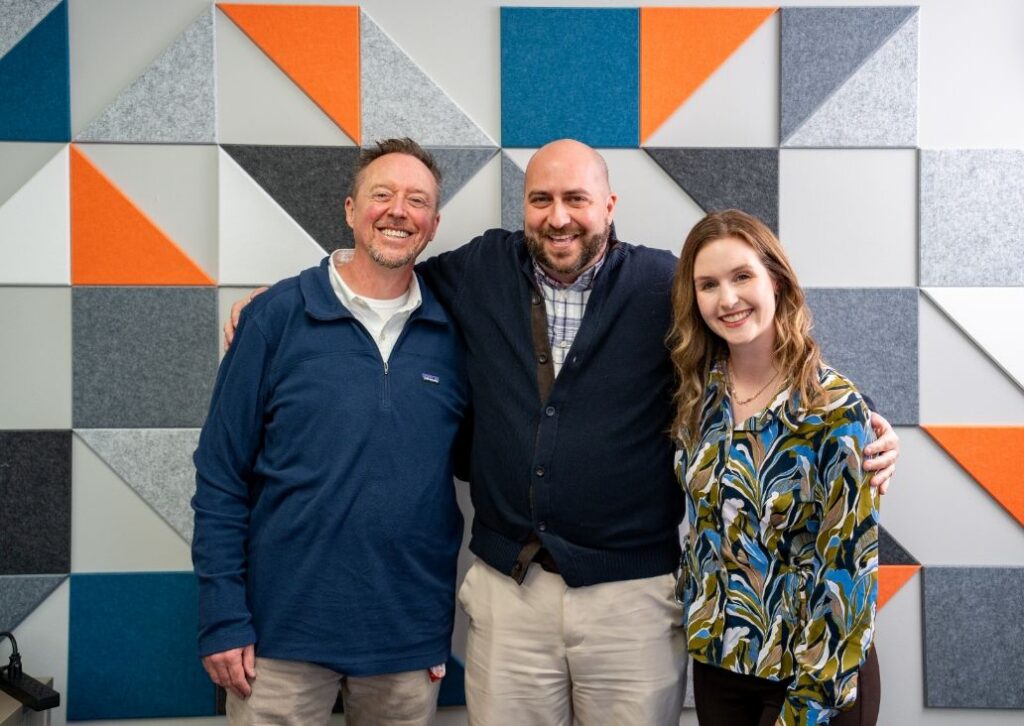
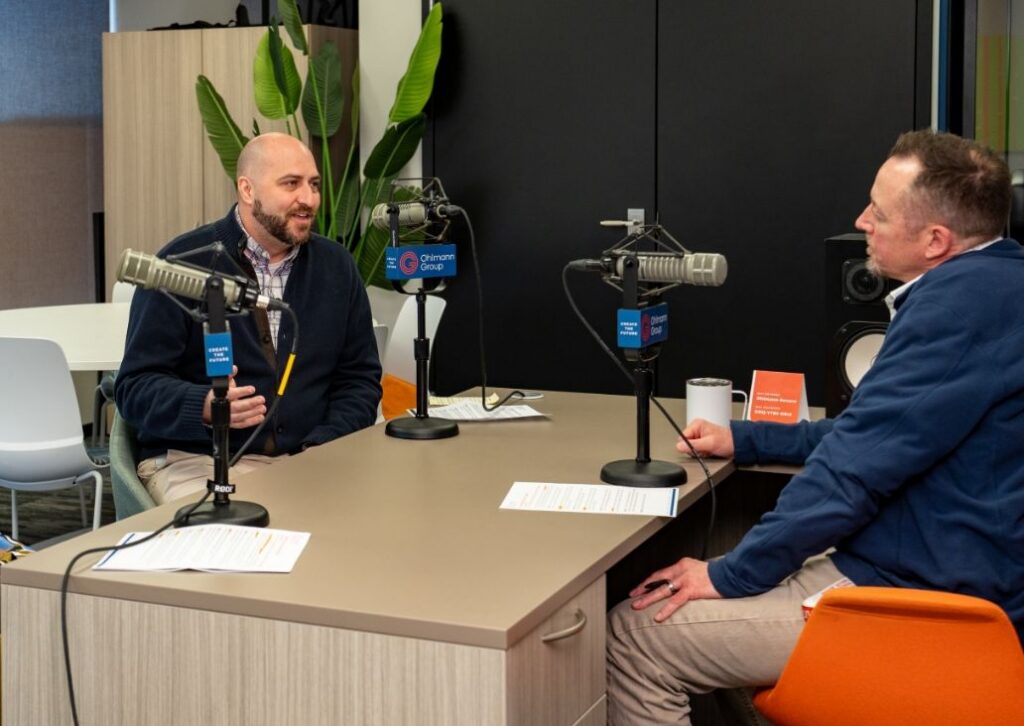
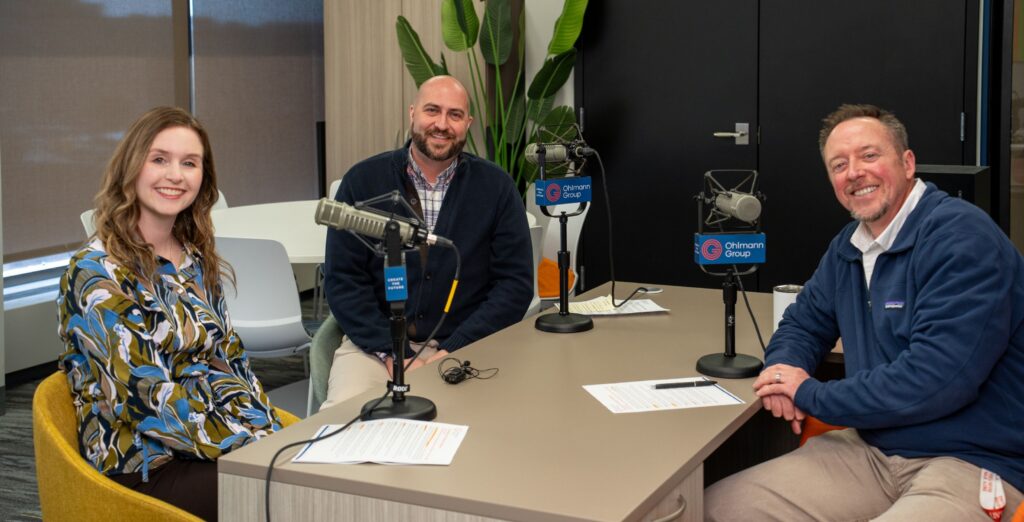
Sean Mitchell is a passionate community advocate with over a decade of experience in human services work. As the Returning Citizen Coordinator for Sinclair College, Sean brings an in-depth perspective on the barriers formerly incarcerated individuals face and the life-changing impact of education, support systems, and fair-chance employment.
Tune in to learn more about the work happening in our region to support citizens returning to the workforce, and how local employers can get involved. You’ll also hear about Sean’s involvement in PechaKucha Dayton, Mr. Rogers’ enduring influence on his life, and what it means to show up for your community. This conversation is a powerful reminder that creating a better future can start with something as simple as being a caring neighbor.
Listen Now

Episode Transcript
Evelyn Ritzi:
Welcome to Creating the Future. I’m Evelyn Ritzi.
David Bowman:
And I’m David Bowman,
Evelyn:
and today we’re joined by a passionate community advocate and a favorite neighbor to so many in Dayton. It’s Sean Mitchell!
Sean Mitchell:
Thanks. Thanks for having me. Super excited to be here with you guys.
Evelyn:
We’re so glad you’re here. We’d love to start with just you and your story. If you could tell us a bit about your background and how you came to call Dayton home.
Sean:
Sure. Yeah, I don’t think it’s too unique in the sense of I did what you know, all good millennials do. Grew up kind of Ludlow Falls, West Milton area, so Miami County, pretty small town, not a lot of diversity there. So ran off to the big city of Toledo for college, right? And had wonderful experiences, but in a less than stellar market, graduating at that time, and did what all good millennials do, and moved in with my roommates, Mom and Dad, and then just kind of started looking for a job, and I started working at our youth homeless shelter daybreak, which was funny, because growing up, I was involved in school and community, because my parents kind of really pushed that and supported that as well. And so all of my teachers, you know, folks at the school, would be like, you’re going to be a social worker. You’re going to be a social worker. Well, I’m happy to note I’m not a social worker, but I did fall into the human services world. So working at daybreak, I fell in love, and then was like, well, here we are. So started falling in love and with Dayton and what the city has to offer. And once you start looking and uncovering those rocks, you really find some neat gems in the city.
David:
So you are now the returning citizen coordinator at St Clair Community College. So tell us about the work you do and why it’s so important for returning citizens and for the entire region.
Sean:
Yeah. So a big thing to kind of start when I was working at Daybreak. You know, we’re working with youth. These are young adults, many of them around early 20s, right? 1819, 20, and some of them may catch a charge for you know that might be a felony or misdemeanor, but that on the record really affected opportunities for these individuals, and I just started realizing that the justice system that we have really always isn’t that just and so really sparked a passion to want to do more, and then really kind of led to where we are now, which is Sinclair is arguably, probably the second largest education provider in prisons in the nation. Yeah, average person has no idea that that’s the case. And so one thing I really noticed is education has kind of become an equalizer for our students really build some social capital. In the state of Ohio, we have a lot of really cool things going on when it comes to it’s shocking to say, well, we have some really progressive ideas around formerly incarcerated. And one of the big things is with education. Specifically, I joke that I’m not a higher ed guy. I just worked for him because that kind of equalizer that you might not necessarily know what a cqe or CAE are, right? And we can talk about those later. But ultimately, that’s kind of just Jarvan jargon, if you will. But really we with by telling somebody you have a degree, I have a college degree, or some college this certification, it really whether your housing provider, whether your employer, it just opens up opportunities and really kind of gets people on a level playing ground.
Evelyn:
What are some of those, those barriers that returning citizens are facing, and where do you see some of the opportunities for change and for solutions?
Sean:
Yeah, so there are over 40,000 what we call collateral consequences nationally, that’s just in, you know, the US, and those are things from not being able to get certain credentials and certified to do certain jobs. It can be barriers on attaining housing, obviously, employment, some neighborhoods that where you can live or not live. It just really those collateral consequences can get in the way. And one of the things. Really works well here in Ohio, the you know, I was talking about that cqe cAe, that’s called the certificate for qualification for employment, or certificate and achievement of employability. It’s unique to Ohio, but it is a specific document that someone who is formerly incarcerated that may not be eligible for record expungement or ceiling. Can apply to that actually, will now take civil liability off of an employer. So if I go and I have a background and, you know, David hires me and I steal something from Evelyn, David doesn’t have to worry about Evelyn saying, Well, I’m gonna sue you for hiring Sean, because you knew that, right? It takes that risk off. What it also does is it opens up some of those licensure options. So it takes away that instant, no, you have this felony background, you can’t get this licensure to support people, or, you know, be involved in fire safety, right? What this also does is it now creates almost like that appeal process. So it forces that licensing board to pause and do an independent review of that individual. They could still say no, yeah, but it forces them to not just say no because of that background. So those are some really cool things that we have in our community. On top of, I have to be honest, montgomery county is probably the best re entry town that I’ve come across nationally so far. We have a dedicated office of reentry, we have an entire coalition with subcommittees that are doing the work that’s important. And then you have places like education, which play a huge role. You have care sources involved. You do have fair chance employers that are getting involved. So it’s really neat to see all those wrap around services for folks.
David:
Taking a quick step back, right? Because language is important. So when we’re saying returning citizens, that might be a term some are not familiar with. So explain that to folks if they’re listening.
Sean:
Yeah, for sure. So terminology kind of matters for a couple reasons, right? Because it’s funny. We’ll talk to some of our students about this, and they’ll be like, well, you know, I don’t care if you know, you consider me an ex con or a felon, but the reality it kind of helps guide where places are. So when we talk about formally incarcerated or returning citizen, it’s somebody that’s coming out of the legal system, which could be jail or prison system impacted. Could be somebody who maybe has a legal charge but didn’t actually spend any time in jail or prison. And then when we talk about things like fair chance or second chance, that’s actually because for some people, they might have applied 19 times to a place, and now’s the time that I really want to bring you in, right? And that really plays into some of the things that are out there for employers to help identify. Because a big thing we hear is, Well, how do I know the difference between that person and that person the same way that you know the difference between that college graduate and that college graduate, you really don’t, but there’s some little things you can look at. So, you know, when we talk about, you know, formerly incarcerated, you know, second chance, fair chance, tend to be more along that language line than maybe ex con or felon friendly, those are kind of some outdated terms.
David:
Yeah. And so I actually just got done reading a really good book called Flourish by Daniel Coyle. And in it, one of the things that they talk about within community is asking people the question, well, what’s the thing you’re going to go and do about it? Right? So if you were going to, you know, leave this meeting with one thing on your to do list, having heard, like, what is that going to be? So along those lines, like, if someone is listening and wants to know how they can help or get involved, right? What’s, what’s a simple thing they can do to start?
Sean:
Yeah, definitely a simple thing is investigate what’s out there. Ask yourself, what really are, you know, the barriers for an individual coming out of incarceration. You know, to throw some numbers out there, in Ohio, we have 18,000 people released every year from incarceration. Those 18,000 people need jobs. They need places to live. They need community and connecting. Some big factors that play into that is how involved people get with services and supports. From my role, we talk a lot. About geography is the biggest factor. You know, Montgomery County, we have a lot of wrap around services. Adams County and Scioto County, they don’t have squat. They got a dude in a computer lab at their community action partnership. And so those communities are going to struggle a little bit more, but they do have people coming back there. So how do you open up, kind of the flood gates or open up that opportunity? And especially, I know a lot of companies are struggling when it comes to hiring people into the workforce and retaining people. Lot of HR organizations, Nash nationally, have come out and said formerly incarcerated and returning citizens tend to have a much lower turnover than most other employees.
Evelyn:
From your perspective, I know you had the chance to attend some of these like graduations and ceremonies. Could you talk a little bit about what it feels like to see folks complete a program, and what does that feel like?
Sean:
Yeah, that’s that’s probably my favorite part. I joke pretty regularly. I kind of hone and moan of Sinclair’s big graduation, right? Just because it’s around dinner time on a Friday night, I’m hungry and it’s hot and it’s just me whining, right? But the reality is seeing our graduations in the actual prisons, because we will hold them. I was just at one this past Friday at Pickaway Correctional Institute, and families come in, and one of the nice things about Pickaway is we happen to have a culinary program there, so we also have students that have prepared all this food to show off for their friends and family. The warden comes. It involves ODRC, Ohio, Department of Rehabilitation and Corrections. It involves their staff and the site staff. It involves Sinclair staff, and then all these students and family where, you know, we hear a lot. The president of Sinclair talks a lot about, you know, how many people said this wasn’t for you? Raise your hand. How many people said college wasn’t for you? And here you are, and that shines so much more when you’re in a prison setting. Another graduation that I will just give some kudos to is our Office of re entry here in montgomery county. They do a monthly cohort for folks coming out. It’s kind of a 11 day intensive folks have worked through. And they also hold a graduation, and I think that’s like every last Thursday of the month, something around there. But it’s really cool. It’s open to the public, and you just see that same feeling that we see inside of just students lighting up. You see, kind of one of the hardest tasks of this role is really rebuilding hope in someone. Because I think the greatest direction that leads folks into that incarceration is that loss of hope, right? And it can come from so many places and ways and trauma, but seeing that start to blossom again is really exciting.
Evelyn Ritzi 13:22
Well, something else you’re involved in locally. Here is PechaKucha or PK Dayton, because you’re just a man about town, really…Could you tell us a little bit more about PK and why people should check it out?
Sean:
Yeah. So gush all day about PK. So for context, what PK is, is it is also Chaka Cha is Japanese for chit chat. So it was a group of architects that got together and said, Hey, we want a succinct way to present the stuff we like, the stuff we think is cool. So it’s a 20 by 20 format. You have 20 slides, all photos, and each one is up for 20 seconds. And you don’t control the slide deck, though. So whether you’re excited or not, you’re up there for six minutes and 40 seconds. That’s it. What I love so much about it is, these are not expert speakers. You know, you can come in. I know Evelyn. You’ve done one. You know David. I don’t know if you have any favorite hobbies, anything that excites you.
David:
Many, many, many
Evelyn:
Too many to count.
Sean:
You could just get up on that stage and say, I want to talk about my favorite butterflies, and just have 20 photos of your favorite butterflies. And I like this one because it’s this and it does this and comes here. It’s like kids talking about, you know, their favorite Pokemon sometimes, right? But we’re adults sharing how much we love this thing. And. And it’s the greatest audience in Dayton, Ohio. It really is. We had somebody get up once and talk about their story, but kind of froze and super nervous, but just had these beautiful slides. And at the end, the entire audience standing ovation, as they were, kind of like freezing up, and it just, it’s a great place to share who you are, and our community has a thirst. And then the best part is, you see those people in your grocery store, and they’re like, Evelyn, I loved your talk. Can you pass that cream over there? But it’s really good.
Evelyn:
Yeah, it combines so many different things. Like, there’s an education piece to it. Like, I know you’ve shared one about your re entry work, and like, you can learn so much from these talks. They can be entertaining. They can be playful and fun. But also, like raising some serious awareness in front of a huge crowd, like the crowd is always completely sold out and it’s always free. I say sold out, but it’s free,
Sean:
Yeah, but I will say, with our problem we do run into now is finding a space large enough for 300 to 400 people, sometimes 450 people that are just coming out, to be a part of a community, to learn to hear people talk about what they care about. It’s really beautiful. And I’ll also add, I was just at a conference last month or last week, and we were invited to this research day, and they had a PK style lightning presentation so that 1520 people could talk about what they were doing work on in a very succinct, easy way. So it works really well for companies and businesses too, to say you got six minutes and 40 seconds to tell us what you’re working on.
Evelyn:
It’s perfect, because if you’re like a more introverted presenter, like having that structure helps to give you enough space to fill what you want to say. And if you’re more excitable, extroverted presenter, who just want, would rather go on and on, it gives you that structure so you cannot do you cannot go on and on. And there are many of us, self included that need that structure and compression. Big talker.
David:
So as someone who’s so involved in the community, what’s one small step that somebody could take to just be a better advocate for where they live?
Sean:
I would say really for this one. You know, I had some ideas and thoughts but, but I think the biggest thing is actually investigating getting involved in what’s in your community. How does it work? How does it run? You know, it’s easy for us to say, Oh, I’m mad at the city for this, or I really hate that nonprofit for this, but then get involved with that nonprofit, get check into the city and say, Hey, what are the rules around this? Is it a law? Is that a law that could be changed? Is that something that had unintended consequences, and could now you get to be the catalyst of making that adjustment. You know, we hear all the time, and I’m sure you guys are aware of the the keyboard warriors that are out there, right where it’s even real easy, really easy to complain about the things I don’t like. But let’s flip that and say, let’s talk about, what are the things I do like, and then let’s talk about, okay, what are the steps I can take? Because at the end of the day, we talk a lot about accountability, but accountability starts with us, and so at the end of the day, I’m just as responsible as somebody in that seat if I’m sitting back and not actually doing something or getting involved.
Evelyn:
Yeah, you show me a lot of just showing up, like being there, being in the room, if you care about something like be there.
Sean:
So you can learn so much from the people doing the work. Because people want to talk about what they do, right? They like it. They typically are enjoyed by it. So therefore, you just strike up a conversation. Tell me about the water management of Dayton Ohio, and you will realize how amazing the water in Dayton Ohio is something that seems so mundane that we just use every day. It’s just interesting and it’s really exciting.
Evelyn:
I like really cannot interview Sean Mitchell without talking about someone very important to you, which would be Mr. Rogers. Can you tell us a little bit about what? What about Mr. Rogers resonates with you and and what does it mean to you?
Sean:
Yeah, I probably appreciated this guy way too much. My only tattoo is a sweater with the number 143, under it, because it represents it was Mr. Rogers favorite number, which stands for, I love you because you have the one letter for i Four letters for love and then three for you. So I say that because I think that, shockingly enough, I watched Mr. Rogers as a kid and Mr. Rogers Neighborhood, but I. Didn’t really fall in love with him until late into high school, early college, and that’s when you start looking at what he actually represented. He was a man that was so devout in his personal faith, but never pushed that on anyone else. The only kind of hate mail that he ever got was from other people of faith, saying, You need to be doing more with your platform. And he would always say the same thing, with grace and poise and kindness and compassion, I’m doing my work through how I live my life, and I can only hope that others might want to emulate that or walk their journey their way. And it really it emphasizes how much emotional intelligence, things like kindness, has, such a level of empathy, the ability put yourself in someone else’s shoes, intelligence, the ability to pause before you react and think, if you find someone with kindness, that is the greatest ability and power that someone has. And what I think is so beautiful is we think about, you know, power, success influences. I worked my way to the top. I put in hundreds of hours, or I, you know, screwed people over to get where I needed to be. Or, you know, lost out on things, when the reality is Fred Rogers had tons of power and influence just because he was a genuine, kind human and liked people. So kindness is power, yeah?
David:
And, well, I’m someone who is old enough to have more than one Mr. Rogers album, ooh, collection, so for sure, now a couple of them also haven’t grown up in the 80s. Might be scratched up for my attempts at DJing and scratching, unfortunately, but we still have, nonetheless,
Sean:
Maybe you should do a PK about your DJing.
David:
There you go. Very short, two scratch record pictures and then six minutes of silence. But you know, one of the things with Mr. Rogers was he wasn’t afraid to have difficult conversations, but do them really respectfully, right? And hold space for people, even with kids, right? Like he’s talking about death or he’s talking about loss or talking about things, but doing it in a way that’s both curious and compassionate, and looking into those things with kindness, right? And trying to understand and create a space for understanding. And I think that’s what like, I’m just always fascinated by that. And then also, like, the just every episode, they’re touring something or doing brand fact, right, right? Like, when you see, like, oh, it’s one big ball and crayon that chops that like, Oh, my God, so cool.
Evelyn:
Like, the soothing nature of how each show starts and
David:
Yeah, like, he’s very calm.
Sean:
I love, there’s an episode where he just simply says, Do you guys want to know how long one minute is? And then he sets a timer, and you sit there for one minute. I mean, I don’t know about you, but I don’t know if your audience is gonna sit here for one minute of silence modern day, but a kid’s gonna be like, I do want to know how long one minute is.
David:
I think, just that courage to again sit for a minute in silence, just to see what it’s like.
Sean:
Absolutely. Yeah, he was, he was a neat guy and and he was very routine and regimented. He he made sure that what he was talking about, he created all the music for the show. But just, I don’t know you hear some of the stories. One quick favorite is his car was stolen. And this is after everybody knew who Mr. Rogers was. And of course, the he’s from Pittsburgh area, La Trobe, and in Pittsburgh, it hits the news that Mr. Rogers vehicle was stolen, right? So a couple days after it was stolen, hits the news. Couple days after that, Fred’s walking out of the studio, and he notices his car is sitting there, and on the dash was a note that said, if I known it was yours, I’d have never taken it. I mean, those kind of things that comes from being a genuine, decent, kind human being, absolutely.
Evelyn:
Yeah, well, you embody that neighborliness. Sean, one final question for you, what’s the future that you want to create?
Sean:
Yeah, I think it plays into kind of what we talked about around Fred and just things that, like Ohio is doing in Montgomery County and Sinclair when it comes to formerly incarcerated individuals. But really we’re a. Helping community. I mean, we have two domestic violence focused organizations in our community when most have none, and I think that plays into what I think we need to create. What I would like us to create and be a part of, are truly safe spaces for everyone. I’ll be up front specifically, we have to do a better job when it comes to women, people of color, individuals out of sexuality and kind of these folks that we talk about on the margins, there’s constantly news articles and updates of you know, areas where you know, women are unsafe in our communities. People of color, trans population, like these individuals, are unsafe where they live. And I think it it again that accountability, it is on us as a community to provide that safety, to make those spaces more approachable, to open up access and opportunity. You know, through incarceration, we see it’s throwing money away for no good reason. You know, cost like $35,000 in the state of Ohio to house somebody that’s incarcerated when you can provide mental health services, housing support and education to get somebody into a workforce that’s building up tax revenue. So if you want to do it by the numbers, that makes sense. But then if you look at it as just the humanistic approach to people, that’s where we’re really doing ourselves a disservice if we’re not supporting individuals and opening up safe, truly safe places for people.
Evelyn:
Thank you, Sean, for sharing so much insight into the work you do in your job and in the community. We appreciate you.
Sean
Thank you for having me. This is great. You guys have the best guests. So I’m honored to be here with all the others. I want to come in and just be like I want to hang out with you guys.
Evelyn
Welcome to the club.
David:
Like a get-together.
Evelyn:
Thank you.
David:
Thank you.